ARGUS vs Solsten: A Feature-by-Feature Comparison for CRE Professionals
If you’ve been underwriting commercial real estate deals, chances are you’ve encountered ARGUS Enterprise — the industry’s 35-year incumbent for institutional-grade property analysis.
But with licensing costs ranging from $3,000 to $10,000 per seat per year, many investors and analysts are asking: is there a better way?
We built Solsten to answer that question. Here’s an honest, feature-by-feature comparison.
Where Both Platforms Deliver
Both Solsten and ARGUS provide:
- Full proforma engines (annual and monthly)
- Rent roll timeline visualization
- Recovery modeling (NNN, Base Year Stop, Modified Gross)
- GP/LP waterfall distributions
- Multi-loan debt modeling with amortization schedules
- Exit scenario analysis with IRR and equity multiples
For core CRE underwriting, both platforms cover the essentials.
Where Solsten Goes Further
ML-Powered Expense Forecasting
ARGUS uses static assumptions — you input a growth rate, and it compounds annually. Solsten does that too, but adds a machine learning layer that learns from your property’s actual payment history.
As you enter actuals, Solsten calculates observed escalation rates and blends them with your assumptions based on statistical confidence. The more data you provide, the more accurate your forecasts become.
Fluid Timeline Intelligence
ARGUS snapshots your analysis at a point in time. Solsten uses a Fluid Timeline Engine that automatically adjusts calculations as time passes:
- Vacancies auto-extend if they exceed the original forecast
- Lease expirations update projections dynamically
- Expense escalations compound from actual payment dates
No manual updates needed.
AI Assistant for Model Q&A
Solsten includes Saga AI assistant for underwriting workflow questions. Instead of generic chatbot responses, Saga is designed to use your property context so you can ask what changed and why across assumptions, timelines, NOI, cash flow, and return outputs.
For a full product-level overview, see our AI assistant for CRE underwriting on the ARGUS alternative page.
Cloud-Based Collaboration
ARGUS is desktop software. Solsten is cloud-native — share properties with team members, manage access with role-based permissions (owner, admin, analyst, viewer), and collaborate in real time from any browser.
15-Factor Risk Scoring
Solsten automatically scores every property across 15 weighted risk factors including WALT, tenant concentration, DSCR, LTV, break-even occupancy, and debt maturity. ARGUS doesn’t offer automated risk assessment.
Where ARGUS Still Leads
We believe in transparency:
- IFRS 16 / ASC 842 compliance — critical for public REITs
- 35+ years of institutional acceptance — deeply embedded in workflows
- On-premise deployment — required by some compliance frameworks
The Bottom Line
For individual investors, small-to-mid firms, and growing portfolios, Solsten provides institutional-grade analysis at 90%+ lower cost with ML features ARGUS doesn’t have.
For public REITs with IFRS mandates and existing ARGUS infrastructure, the switching cost may still favor staying.
The best way to decide? Try Solsten free — no credit card required — and run a side-by-side comparison with your own data.
FAQs
Is Solsten really free? Solsten has a Free plan with no credit card required — one property, one analysis per month, the full proforma engine, ML-powered forecasting, and Excel import. Paid plans start at $99/mo (Starter) and $179/mo (Professional, includes 2 editor seats) for unlimited analyses, more properties, and team collaboration. At a fraction of ARGUS Enterprise pricing.
Can Solsten replace ARGUS for my team? For most small-to-mid firms and individual investors, yes. Solsten covers all core underwriting functions — proforma, rent roll, recoveries, waterfalls, and exit analysis — plus ML-powered forecasting that ARGUS doesn’t offer. Public REITs requiring IFRS 16 compliance may still need ARGUS.
What metrics does Solsten calculate automatically? Solsten calculates IRR (levered and unlevered), NPV, cash-on-cash return, cap rates, DSCR, NOI, and full operating statement projections.
Does Solsten have an AI assistant for underwriting? Yes. Solsten includes Saga AI assistant so you can ask model-specific questions during underwriting and review. See the AI assistant for CRE underwriting comparison.
How does ML-powered forecasting work? As you enter actual expense payments, Solsten calculates observed escalation rates and blends them with your assumptions based on statistical confidence. The more data you provide, the more accurate your forecasts become — something static tools like ARGUS can’t do.
Related Articles
- The Best Free Commercial Property Valuation Tools (2025) — Hands-on review of 8 free platforms
- Top 10 Commercial Real Estate Portfolio Management Software — Full platform comparison
- Mastering IRR and NPV — Deep dive into the return metrics Solsten calculates automatically
Explore Solsten
- ARGUS Alternative — See the Full Comparison — Side-by-side breakdown of Solsten vs ARGUS
- CRE Proforma Software — Institutional-grade operating statements with ML-powered forecasting
- All Features — Everything Solsten offers for CRE analysis
Continue the Comparison Path
- Excel vs CRE Underwriting Software — See where spreadsheet workflows break under deal complexity
- Commercial Real Estate DCF Analysis Software — Review IRR, NPV, and exit-scenario workflows
- Commercial Real Estate Proforma Software — Validate monthly and annual statement outputs
- ARGUS Alternative Software Comparison — Return to the full competitor comparison page
Try Solsten Free
See everything we discussed in action — no credit card required.
Start Your Free AnalysisRelated Articles
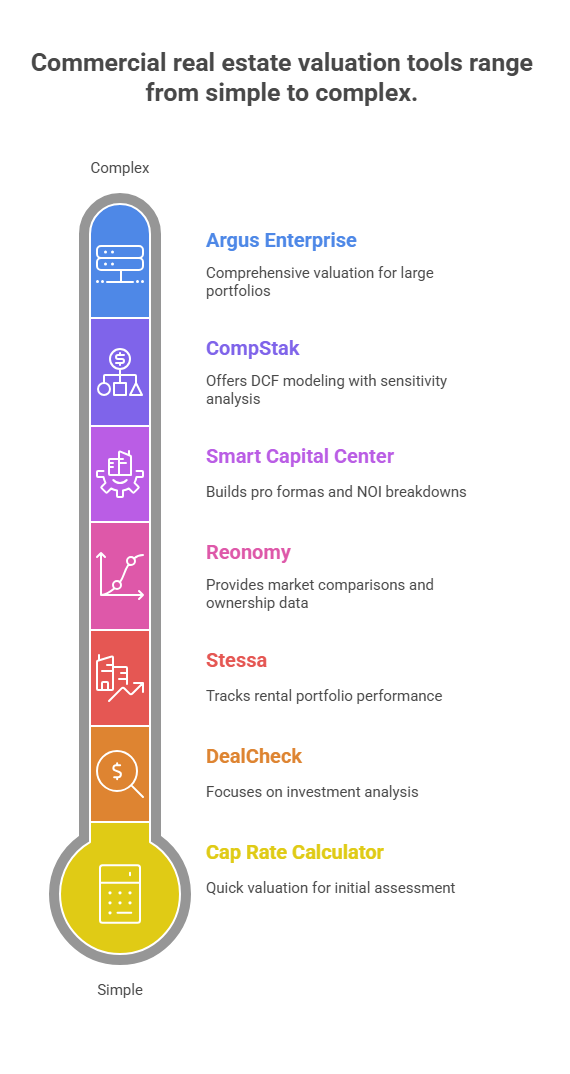
The Best Free Commercial Property Valuation Tools (Tried & Tested for 2026)
Hands-on review of the best free commercial property valuation software for 2026 — from AI-powered valuations to institutional-grade DCF modeling platforms.
Best Commercial Property Valuation Tools, Cap Rate Calculators & Value-Add vs. Core-Plus Strategy (2026)
A deep dive into the best commercial property valuation tools and cap rate calculators for 2026, plus how to choose between value-add and core-plus investment strategies.
Top 10 Commercial Real Estate Portfolio Management Software (2025)
A research-backed analysis ranking the top 10 CRE portfolio management platforms for 2025 — from free-tier platforms like Solsten to enterprise solutions like ARGUS and MRI.