Best Commercial Property Valuation Tools, Cap Rate Calculators & Value-Add vs. Core-Plus Strategy (2026)

In today’s data-driven real estate market, knowing a property’s true worth goes far beyond gut instinct or guesswork. The smartest investors now rely on advanced commercial property valuation tools and cap rate calculators to turn raw numbers into clear insights. Whether you’re analyzing a multifamily acquisition, an office repositioning, or weighing a value-add vs. core-plus strategy, precision is everything.
Understanding Commercial Property Valuation
Commercial property valuation isn’t just about putting a price tag on a building — it’s about decoding how that property performs as a living, breathing financial asset. Investors, lenders, and portfolio managers all rely on precise valuation to make intelligent decisions. Yet beyond the spreadsheets and projections lies something more nuanced: a blend of data, intuition, and market timing.
The Core Methods Behind Property Valuation
There are three fundamental property valuation methods every commercial investor should know:
| Method | How It Works | Best For | Key Inputs |
|---|---|---|---|
| Income Approach | Determines value based on net income potential | Rental or leased properties | Cap rate formula, NOI |
| Cost Approach | Estimates value based on replacement or reproduction cost | Unique or newly built properties | Depreciation, construction costs, land value |
| Sales Comparison | Compares subject property with recent market transactions | Common commercial assets | Market comps, adjusted ROI models |
Mastering the Income Approach
The income approach is the most widely used method in CRE investment analysis. The concept is simple: the more consistent income a property generates, the more valuable it is.
Start with Net Operating Income (NOI) — revenue minus operating expenses — then divide by the capitalization rate:
Value = NOI ÷ Cap Rate
For example, if a retail property produces $240,000 in annual NOI and the market cap rate is 8%:
$240,000 ÷ 0.08 = $3,000,000
That number isn’t just math — it’s the heartbeat of a deal. Investors use tools to simulate this calculation, running multiple scenarios for rent escalation, vacancy shifts, or refinancing outcomes.
Strategic Valuation Insights: Market Dynamics
A property’s worth can fluctuate with:
- Tenant credit quality — Stronger tenants support higher valuations
- Supply-demand imbalance — Local market dynamics shift cap rates
- Lease structure — Gross vs. triple-net affects NOI composition
- Broader economic trends — Interest rates, employment, inflation
A savvy analyst doesn’t just calculate value — they interpret it, blending financial data with local intel. That’s what distinguishes a core-plus investment strategy from a value-add play: one optimizes stability, the other seeks transformation.
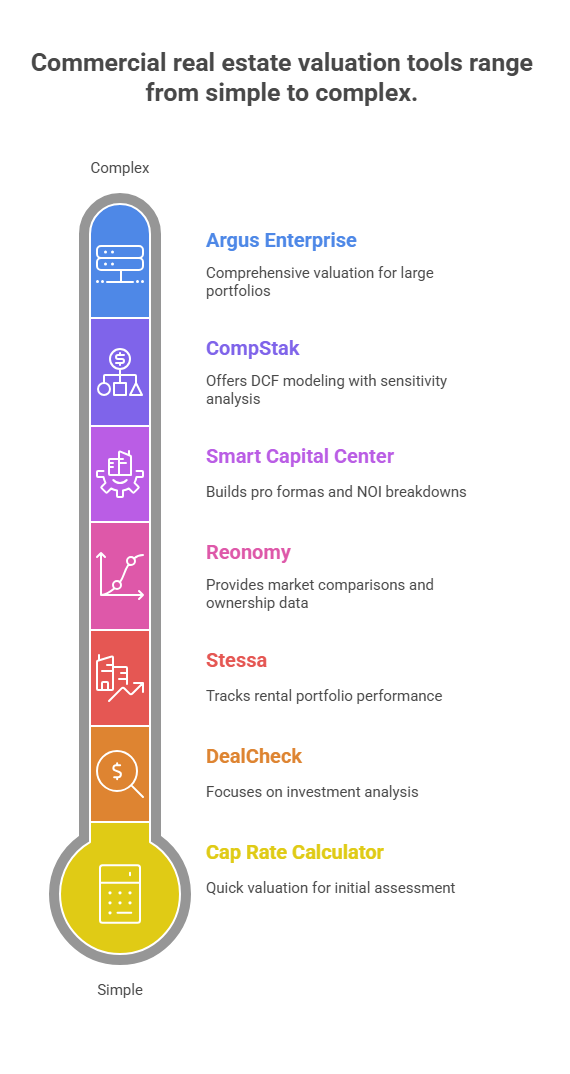
Best Commercial Property Valuation Tools of 2025
Nordic Real Estate Services — Solsten
Best For: New and cost-conscious investors, small teams that want speed and clarity
The most powerful free commercial valuation platform available. Institutional-grade features including DCF modeling, recovery types, capital reserves, IRR, NPV, and comprehensive proforma generation — all within a clean web application at no cost.
Reonomy
Best For: Brokers, investors, and researchers who need data at scale
Nationwide commercial property database with ownership records, sales history, debt data, and comps. Powerful filters for prospecting owners and sourcing off-market deals. 7-day free trial, then ~$400/month.
CREModels — The CRE Suite
Best For: PE real estate firms, investment and development teams
Collaborative pipeline and modeling hub replacing scattered spreadsheets with a single, shared system. Strong for teams that need unified deal flow management.
PropertyMetrics
Best For: Investors, appraisers, and brokers wanting ARGUS-style outputs without ARGUS complexity
Fast DCF and cap rate calculations with clean reporting. Solid choice for small to mid-size shops that need speed and professional outputs.
Valuate by REFM
Best For: Brokers pitching listings and sponsors raising equity
Excel-friendly instant sensitivity testing and back-of-the-envelope speed with professional-level clarity. Base templates available for free.
ARGUS Enterprise
Best For: REITs, funds, lenders, and appraisal firms
The industry standard for institutional-grade forecasting. Deep valuation and analysis modeling with extensive scenario testing. Complex office, retail, and industrial assets with many tenants. Pricing: $3,000–$10,000+ per seat per year.
CoStar
Best For: Brokers, appraisers, and investors who need current comps and market context
The largest commercial real estate database. Teams use it to ground underwriting in real data with verified comps and market analytics.
Buildium
Best For: Owners and managers who want smoother operations and steady cash flow
Mixed or commercial portfolios where clean books feed better valuations. Strong accounting and day-to-day operational management.
Demystifying Cap Rate Calculators
Every investor talks about cap rates, but few truly use them well. A cap rate calculator takes your NOI and divides it by the purchase price or current value — that’s your capitalization rate in its simplest form.
For example, if a property earns $120,000 in NOI and sells for $2 million, the cap rate is 6%. The trick is interpreting what that 6% means in context. In Miami or Dallas, a 6% cap might be considered aggressive; in smaller markets, it could signal higher risk.
Key Factors Influencing Cap Rates
- Interest rates and cost of capital — When debt is cheap, investors accept lower cap rates
- Occupancy rate and tenant quality — Creditworthy tenants support tighter spreads
- Location risk — Urban infill properties tend to price lower caps than suburban assets
- Lease-up period — Properties in lease-up carry higher required returns
- Asset type and WALE — Weighted average lease expiry affects risk perception
Cap Rate Calculator Tools
| Tool | Best For | Audience |
|---|---|---|
| PropertyMetrics | Fast DCF and cap rate calculations | Analysts and appraisers |
| Valuate (REFM) | Instant sensitivity testing | Brokers and investors |
| Solsten | Free, comprehensive modeling | All investors |
| ARGUS Enterprise | Institutional-grade forecasting | REITs and large funds |
Value-Add vs. Core-Plus Strategy
Your valuation tool is only as useful as the strategy guiding it. Two of the most talked-about investment approaches are value-add and core-plus — and their DNA is simple: how much risk are you willing to take for a higher return?
What Is a Value-Add Strategy?
A value-add strategy means buying underperforming properties — maybe a retail center with outdated signage or a multifamily building needing renovations — and creating new value through active management.
Common tactics include:
- Renovating common areas or unit interiors
- Re-tenanting vacant spaces at market rates
- Refinancing after stabilization to pull out equity
- Improving operational efficiency through technology or energy retrofits
What Is a Core-Plus Strategy?
Core-plus sits between conservative and adventurous. These are assets already performing well — think Class A buildings in good markets — with light growth potential. The aim is steady income with mild appreciation.
Key characteristics:
- Strong tenancy and occupancy rate
- Minor cosmetic or operational enhancements
- Typically levered around 60–70% LTV for stable returns
- Consistent cash flow with moderate upside
Comparing Value-Add vs. Core-Plus
| Factor | Value-Add | Core-Plus |
|---|---|---|
| Risk Profile | Moderate to High | Low to Moderate |
| Target Returns | 12–18% IRR | 8–12% IRR |
| Capital Intensity | Heavy (Renovations, CapEx) | Light (Cosmetic or Efficiency) |
| Hold Period | 3–7 years | 5–10 years |
| Income Stability | Unstable initially | Steady from Day One |
| Cap Rate at Entry | Higher (reflects risk) | Lower (reflects stability) |
FAQs
What is the best commercial property valuation software for beginners? Solsten offers the most powerful free modeling available, making it ideal for beginners who want institutional-grade tools without subscription costs.
How often should I update my property valuation? At minimum, annually — or whenever there’s a lease event, market shift, or capital improvement that materially affects income or expenses.
What is a healthy cap rate for commercial properties? It depends on asset class and market. Generally, 5–7% for stabilized assets in strong markets, 7–10% for value-add or secondary markets. Always compare to local benchmarks.
Can small investors use tools like ARGUS Enterprise? Technically yes, but ARGUS’s cost ($3K–$10K+/year) and learning curve make it impractical for most small investors. Platforms like Solsten — with a free tier and paid plans from $99/mo — deliver comparable analysis at a fraction of the cost.
Which strategy offers better long-term stability — value-add or core-plus? Core-plus offers more stability with steady income from day one. Value-add offers higher potential returns but carries execution risk during the renovation and lease-up period.
Related Articles
- How to Underwrite a Value-Add Property — Step-by-step underwriting for value-add deals
- Cap Rates: Do They Really Matter? — Why cap rate alone can mislead investors
- Cash-on-Cash Return Explained — How to measure actual cash yield on your equity
- The Best Free Commercial Property Valuation Tools (2025) — Hands-on review of 8 free platforms
- Mastering IRR and NPV — Investment return fundamentals for informed decisions
Explore Solsten
- CRE Proforma Software — Operating statements with NOI, cash flow, and cap rate analysis
- 15-Factor Risk Scoring — Quantitative risk assessment including DSCR, LTV, and WALT
- All Features — See everything Solsten offers
Try Solsten Free
See everything we discussed in action — no credit card required.
Start Your Free AnalysisRelated Articles
The Best Free Commercial Property Valuation Tools (Tried & Tested for 2026)
Hands-on review of the best free commercial property valuation software for 2026 — from AI-powered valuations to institutional-grade DCF modeling platforms.
ARGUS vs Solsten: A Feature-by-Feature Comparison for CRE Professionals
Detailed feature-by-feature comparison of ARGUS Enterprise and Solsten for CRE analysis. See where each platform excels, pricing differences, and which is right for your workflow.

CRE Portfolio Management Software 2026: Investment Analytics vs. Property Ops
10 CRE portfolio platforms compared: Solsten, ARGUS, MRI, AppFolio and more. Investment analytics + LP/GP waterfalls vs. property operations, side by side.