What Is NOI in Commercial Real Estate? The Complete Guide
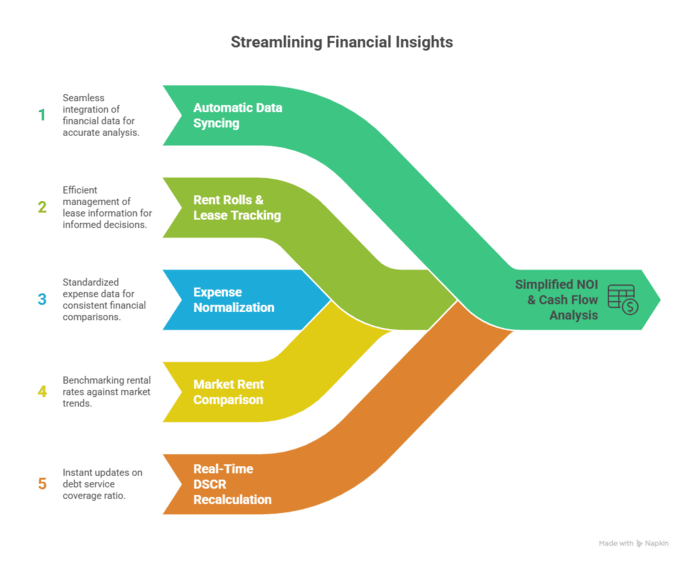
Net Operating Income is the single most important number in commercial real estate. Every cap rate, every loan sizing, every valuation model starts here. If you get NOI wrong, everything downstream is wrong too.
This guide walks through exactly how NOI is calculated, what belongs in operating expenses (and what doesn’t), and how lenders, appraisers, and investors use it.
The NOI Formula
That’s it. No debt service, no capital expenditures, no income taxes. NOI measures how much cash the property generates from operations before financing decisions.
Breaking Down Effective Gross Income (EGI)
Effective Gross Income starts with Potential Gross Income (PGI) — the total rent if every unit were leased at market rates for the entire year — then subtracts vacancy and credit loss and adds other income:
\text{EGI} = \text{PGI} - \text{Vacancy & Credit Loss} + \text{Other Income}What counts as PGI:
- Contract rent from all leased spaces
- Market rent for vacant spaces (what you could charge)
- Scheduled rent increases (step increases, CPI bumps)
What counts as Other Income:
- Parking fees
- Antenna/billboard rent
- Vending income
- Late fees and percentage rent
- Expense recoveries (CAM, tax, insurance pass-throughs)
What Counts as Operating Expenses
Operating expenses are the recurring costs of running the property. They’re typically divided into controllable and non-controllable categories:
Controllable expenses:
- Property management fees (typically 3–6% of EGI)
- Repairs and maintenance
- Utilities (if not tenant-paid)
- Janitorial and landscaping
- Marketing and leasing costs
- Administrative costs
- Insurance
Non-controllable expenses:
- Real estate taxes
- Government assessments
- Ground lease payments (if applicable)
What Does NOT Belong in NOI
This is where most mistakes happen. These items are excluded from the NOI calculation:
| Excluded Item | Reason |
|---|---|
| Debt service (mortgage payments) | Financing decision, not operational |
| Capital expenditures (roof, HVAC replacement) | One-time, not recurring operations |
| Depreciation | Accounting entry, not cash flow |
| Income taxes | Owner-specific, vary by structure |
| Tenant improvements | Leasing cost, not operations |
| Leasing commissions | Leasing cost, not operations |
Think of NOI as the property’s earning power independent of who owns it, how it’s financed, and what tax bracket the owner is in.
NOI Calculation Example
Let’s walk through a 10,000 SF office building:
| Line Item | Amount |
|---|---|
| Potential Gross Income | |
| Contract rent (8,500 SF × $20/SF) | $170,000 |
| Market rent for vacant space (1,500 SF × $18/SF) | $27,000 |
| Total PGI | $197,000 |
| Less: Vacancy & Credit Loss (5%) | ($9,850) |
| Plus: Parking income | $12,000 |
| Plus: CAM recoveries | $15,000 |
| Effective Gross Income | $214,150 |
| Operating Expenses | |
| Real estate taxes | $28,000 |
| Insurance | $8,500 |
| Utilities | $14,000 |
| Repairs & maintenance | $10,000 |
| Management fee (5% of EGI) | $10,708 |
| Janitorial | $6,000 |
| Landscaping | $3,500 |
| Administrative | $2,000 |
| Total Operating Expenses | $82,708 |
| Net Operating Income | $131,442 |
This $131,442 NOI is what the property produces before any mortgage payment, capital improvement, or tax obligation.
How NOI Drives Property Value
Cap Rate Valuation
The most common valuation method divides NOI by the cap rate:
Using our example at a 7% cap rate:
A $10,000 increase in NOI at a 7% cap rate adds $142,857 in property value. This is the multiplier effect that makes NOI management so critical.
Debt Sizing (DSCR)
Lenders use NOI to determine how much they’ll lend. The Debt Service Coverage Ratio measures the cushion between NOI and annual debt payments:
Most lenders require DSCR ≥ 1.25×, meaning $1.25 of NOI for every $1.00 of debt service. With our $131,442 NOI:
That’s the maximum annual mortgage payment a lender would allow — directly constrained by NOI.
Operating Expense Ratio
The operating expense ratio tells you how efficiently the property runs:
Industry benchmarks vary by property type — office buildings typically run 35–45%, industrial 20–30%, retail 25–40%. If your OER is significantly above the benchmark, there may be room to improve NOI through expense management.
NOI vs. Cash Flow: What’s the Difference?
NOI tells you what the property earns. Cash flow tells you what the owner keeps:
Example using our numbers:
| Item | Amount |
|---|---|
| NOI | $131,442 |
| Less: Debt service | ($85,000) |
| Less: Capital reserves | ($5,000) |
| Cash Flow Before Tax | $41,442 |
NOI is the property’s performance metric. Cash flow is the investor’s return metric. Both matter, but NOI is the standard comparison point because it strips out financing and ownership-specific costs.
Common NOI Mistakes to Avoid
1. Including debt service in expenses The most common error. Mortgage payments are a financing choice, not a property operating cost. Two owners with different LTVs on the same building should calculate identical NOIs.
2. Mixing capital expenses with operating expenses A $50,000 roof replacement is a capital expenditure, not an operating expense. Including it artificially depresses NOI in that year. Use a reserve line item for budgeting, but keep it below the NOI line.
3. Using gross income instead of effective gross income Forgetting to deduct vacancy or add other income distorts NOI in both directions. Always start with PGI, adjust for vacancy, and add all ancillary income.
4. Ignoring management fees for self-managed properties Even if you manage the property yourself, include a market-rate management fee. This ensures the NOI reflects what any buyer would achieve, not just an owner-operator.
5. Using trailing NOI for future projections Historical NOI is a starting point, not a forecast. Rents escalate, expenses inflate, and vacancies change. Use trailing NOI for current valuation but build a proforma for forward-looking analysis.
How to Automate NOI Analysis
Building a complete operating statement by hand means tracking dozens of expense line items, forecasting rent escalations, applying inflation rates, and recalculating every time an assumption changes.
Compass automates the entire process — enter your property details, expenses, and tenant leases, and get a full operating statement with NOI calculated annually and monthly. The ML-powered forecasting engine applies inflation, tracks variable occupancy, and projects cash flows over your entire hold period.
Key Takeaways
- NOI = Effective Gross Income − Operating Expenses (no debt, no capex, no taxes)
- A small NOI increase creates a large value increase through the cap rate multiplier
- Lenders size loans directly from NOI via the DSCR
- Always include a management fee, even for self-managed properties
- Use proforma NOI (not just trailing) for investment decisions
Related Articles
- Cap Rates: Do They Really Matter? — How cap rates use NOI and where the metric falls short
- Cash-on-Cash Return Explained — The return metric that picks up where NOI stops
- Mastering IRR and NPV — Time-value-of-money analysis using multi-year NOI projections
Explore Compass
- CRE Proforma Software — Full operating statements with NOI, cash flow, and cap rate analysis
- 15-Factor Risk Scoring — Quantitative risk assessment including DSCR and break-even occupancy
- All Features — See everything Compass offers for CRE analysis
Try Compass Free
See everything we discussed in action — no credit card required.
Start Your Free Analysis