How to Calculate Operating Expenses for Commercial Real Estate
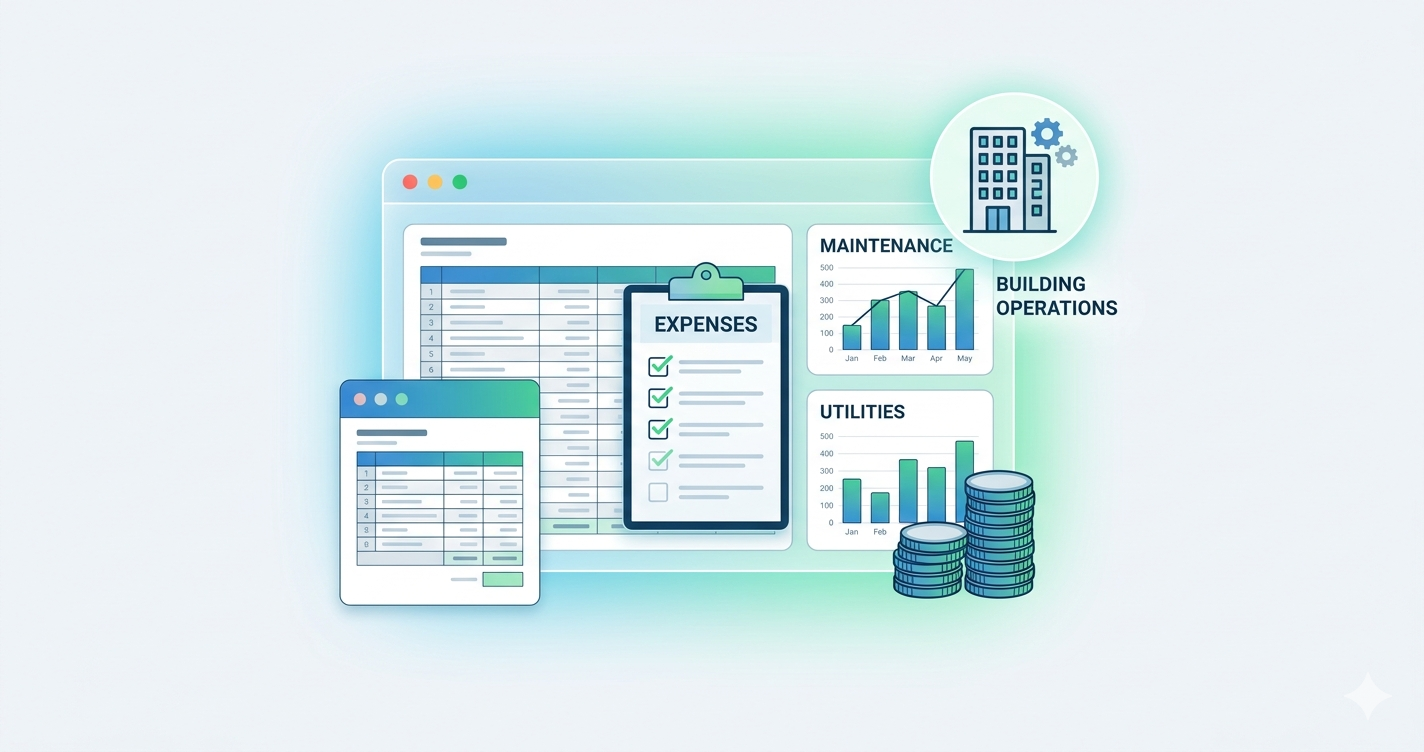
Operating expenses are the single biggest area where CRE underwriting models break down. Not because the math is hard — but because analysts categorize things wrong, miss the fixed vs. variable distinction, or lump above-the-line and below-the-line items together.
This guide breaks down how to properly model operating expenses for commercial real estate, why it matters for your NOI and investment returns, and the common mistakes that lead to inaccurate projections.
What Are Operating Expenses in CRE?
Operating expenses (OpEx) are the recurring costs required to run and maintain a commercial property. They sit between Effective Gross Income (EGI) and Net Operating Income (NOI) on the operating statement:
Potential Gross Income (PGI)
  − Vacancy & Credit Loss
= Effective Gross Income (EGI)
  − Operating Expenses ← This is what we're talking about
= Net Operating Income (NOI)
NOI is the single most important number in CRE valuation. It drives cap rate calculations, debt service coverage ratios (DSCR), and ultimately what the property is worth. If your operating expenses are wrong, your NOI is wrong, and every metric that depends on it is unreliable.
The Standard Operating Expense Categories
Most institutional CRE firms model expenses line by line. Here are the standard categories:
Property Taxes
Usually the largest single expense. Property taxes are assessed by the local government and generally increase annually. Key considerations:
- Check if the property was recently reassessed (or will be upon sale)
- Tax rates vary dramatically by jurisdiction
- Some markets have tax abatements or PILOT programs that expire
- Always check the assessor’s website — don’t just take the seller’s T-12 at face value
Insurance
Property insurance premiums cover fire, liability, natural disasters, and business interruption. Important factors:
- Location-dependent: Coastal and flood zone properties can be 3-5x higher
- Trending upward: Insurance costs have escalated significantly in markets like Florida, California, and Texas
- Premium changes can be lumpy — a single claim can spike your rate
Common Area Maintenance (CAM)
The cost to maintain shared spaces — lobbies, parking lots, hallways, landscaping, common restrooms. CAM includes:
- Janitorial and cleaning services
- Landscaping and snow removal
- Parking lot maintenance and striping
- Common area lighting and HVAC
- Elevator maintenance (if applicable)
Utilities
Electricity, gas, water, sewer, and trash removal. Important to understand who pays:
- Landlord-metered: Landlord pays, may recover through CAM
- Tenant-metered: Tenant pays directly to utility company
- Sub-metered: Landlord pays master meter, allocates to tenants
Management Fees
Typically 3-6% of EGI for third-party management. Even owner-managed properties should include a management fee in underwriting because:
- It reflects the true cost of operating the property
- Lenders and appraisers will include it regardless
- If you sell, the buyer will underwrite with management fees
Repairs and Maintenance
Day-to-day upkeep — HVAC repairs, plumbing fixes, electrical work, painting, etc. This is NOT capital expenditures (CapEx). The distinction matters:
- R&M: Keeps existing systems running. Expense above the NOI line.
- CapEx: Replaces or significantly improves systems. Below the NOI line.
Professional Services
Legal fees, accounting, environmental consultants, lease review. Often lumped into “General & Administrative” but worth separating if material.
Fixed vs. Variable: The Distinction That Changes Everything
This is where most basic Excel models fail. Not all operating expenses behave the same way when occupancy changes.
Fixed Expenses
These costs don’t change (much) regardless of occupancy:
- Property taxes — assessed on the building, not the tenants
- Insurance — premium based on replacement value, not occupancy
- Base management fees — often have a minimum
- Security (if contracted)
A vacant building still owes property taxes and insurance.
Variable Expenses
These scale with how many tenants are in the building:
- Utilities — an empty floor uses less electricity
- Janitorial — fewer occupied suites means less cleaning
- Repairs & maintenance — less wear and tear with fewer tenants
- Trash removal — scales with occupancy
Why This Matters for Underwriting
If you model all expenses as fixed, your vacancy sensitivity analysis will be too optimistic. Here’s why:
Say your building has $500K in operating expenses and you’re modeling a drop from 95% to 75% occupancy.
Wrong approach (all expenses treated as fixed):
At 95% occupancy: $500K expenses, $950K rent → $450K NOI
At 75% occupancy: $500K expenses, $750K rent → $250K NOI
Correct approach (split 60% fixed / 40% variable):
At 95% occupancy: $300K fixed + $200K variable = $500K total
At 75% occupancy: $300K fixed + $158K variable = $458K total
NOI at 75%: $750K rent − $458K expenses = $292K NOI
The difference is $42K in NOI — which at a 6% cap rate represents a $700K difference in property value. Not trivial.
Above the Line vs. Below the Line
“The line” is NOI. This distinction determines what counts as an operating expense and what doesn’t.
Above the Line (Operating Expenses)
Everything discussed above. These reduce your NOI:
- Property taxes, insurance, CAM, utilities, management, R&M
Below the Line (Non-Operating)
These come AFTER NOI and do NOT reduce it:
- Debt service — principal and interest payments
- Capital expenditures — roof replacements, HVAC systems, parking lot repaving
- Tenant improvements — buildout costs for new/renewing tenants
- Leasing commissions — broker fees for tenant placement
- Reserves — annual set-aside for future CapEx
Why Lenders Care
When a bank calculates DSCR, they use this formula:
DSCR = NOI ÷ Annual Debt ServiceIf you accidentally include CapEx or debt service above the NOI line, your DSCR looks worse than it is. If you exclude legitimate operating expenses, your DSCR looks better than it is. Both are problems.
Expense Escalation: How Costs Grow Over Time
Operating expenses don’t stay flat. In a multi-year proforma, you need to escalate expenses realistically.
Common Approaches
Flat rate: Apply 3% annual growth to all expenses. Simple but imprecise — insurance might grow 8% while utilities grow 2%.
Line-by-line: Different escalation rates per category. More accurate:
- Property taxes: 2-4% (follow local reassessment trends)
- Insurance: 5-8% (trending higher in most markets)
- Utilities: 2-3% (relatively stable)
- CAM/R&M: 3-4% (tracks general inflation)
- Management fees: grows automatically if tied to % of EGI
Actual-based: Use 3+ years of historical data to derive observed escalation rates, then blend with market assumptions. This is the most accurate approach and what institutional shops use.
The Year 6+ Problem
Most rate assumptions cover 1-5 years. For years 6+, best practice is to revert to a long-term market consensus rate (typically 3%) rather than extending a short-term trend indefinitely. A 7% insurance escalation rate extrapolated to year 10 produces unrealistic numbers.
Recovery Integration: Who Actually Pays?
In multi-tenant commercial properties, lease structures determine which operating expenses get passed through to tenants. The three main structures:
Triple Net (NNN)
Tenant pays their pro-rata share of ALL operating expenses. Landlord’s NOI is essentially the base rent. Operating expenses flow through.
Base Year Stop
Tenant pays their pro-rata share of operating expense increases ABOVE the base year amount. The base year is typically the first year of the lease. Over time, as expenses escalate, the tenant’s share grows.
Modified Gross
Landlord includes certain expenses in the base rent (often insurance and taxes) and passes through others separately.
Why This Matters for Expense Modeling
If you’re underwriting a multi-tenant property, you need to model expenses AND recoveries together. Your “net” operating expense exposure depends on:
- Each tenant’s lease structure (NNN, Base Year, Modified Gross)
- Each tenant’s base year amounts (for Base Year Stop leases)
- The total expense escalation over the hold period
- Vacancy — vacant suites don’t pay recoveries
Getting recoveries right is arguably the hardest part of CRE underwriting. The expense model feeds directly into it.
Common Mistakes to Avoid
1. Using percentage of revenue instead of line items “Operating expenses = 40% of EGI” tells you nothing about which costs are fixed, which are variable, which escalate faster, and which are recoverable. Always model line by line.
2. Ignoring the T-12’s context A T-12 is historical. It might include one-time items (roof repair coded as R&M), miss items the owner self-managed, or reflect below-market taxes that will reset on sale.
3. Not adjusting for reassessment In most jurisdictions, property taxes are reassessed upon sale based on the purchase price. If you’re buying at a higher basis, your taxes will jump. Always model post-acquisition taxes.
4. Forgetting management fees on owner-operated Even if the current owner manages the property themselves, your underwriting should include management fees. Every buyer, lender, and appraiser will.
5. Confusing CapEx with operating expenses A $50K HVAC replacement is CapEx (below the line). A $2K HVAC repair is R&M (above the line). Mixing these up inflates or deflates your NOI.
Putting It All Together
A properly modeled expense section should:
- ✅ List every expense category as a separate line item
- ✅ Classify each as fixed, variable, or partially variable
- ✅ Apply category-specific escalation rates
- ✅ Separate operating (above-line) from non-operating (below-line)
- ✅ Account for recovery structures per tenant
- ✅ Adjust variable expenses for projected occupancy changes
- ✅ Flag any assumptions that differ from historical (T-12) data
Your operating expenses aren’t just a number to subtract from revenue. They’re the foundation of your NOI, your DSCR, your valuation, and ultimately your investment decision. Getting them right is the difference between a deal that works and a deal that blows up.
Key Takeaways
- Always model expenses line by line — percentages of revenue hide critical information
- Split fixed vs. variable — your vacancy sensitivity depends on it
- Keep operating above the line, non-operating below — DSCR and cap rate calculations depend on clean NOI
- Escalate by category — insurance, taxes, and utilities don’t grow at the same rate
- Adjust for recoveries — your net expense exposure depends on lease structures
- Check the T-12 critically — historical data has context that raw numbers don’t show
Try Solsten Free
See everything we discussed in action — no credit card required.
Start Your Free AnalysisRelated Articles
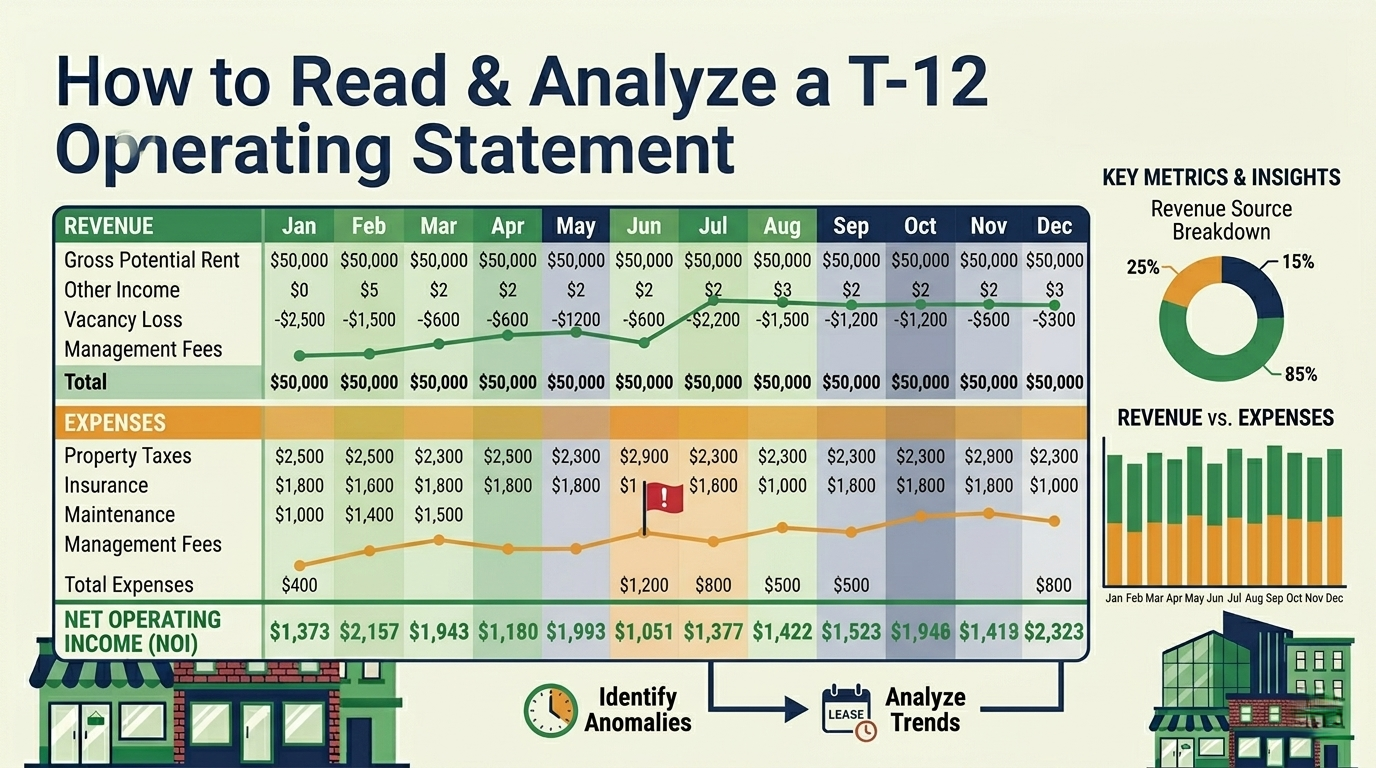
How to Read and Analyze a T-12 Operating Statement
Complete guide to reading a T-12 (trailing twelve months) operating statement for commercial real estate — line-by-line breakdown, red flags, normalization techniques, and how to turn a T-12 into proforma assumptions.
How to Build a Real Estate Proforma: Step-by-Step Guide
Learn how to build a commercial real estate proforma from scratch — revenue projections, expense modeling, NOI, debt service, cash flow, and return metrics explained with examples.
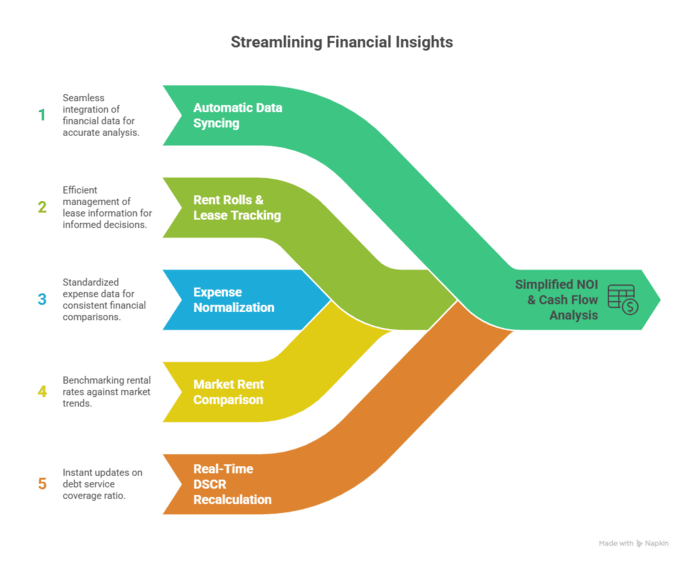
What Is NOI in Commercial Real Estate? The Complete Guide
Net Operating Income (NOI) explained — formula, calculation examples, what to include and exclude, and how NOI drives cap rates, debt sizing, and property valuation.